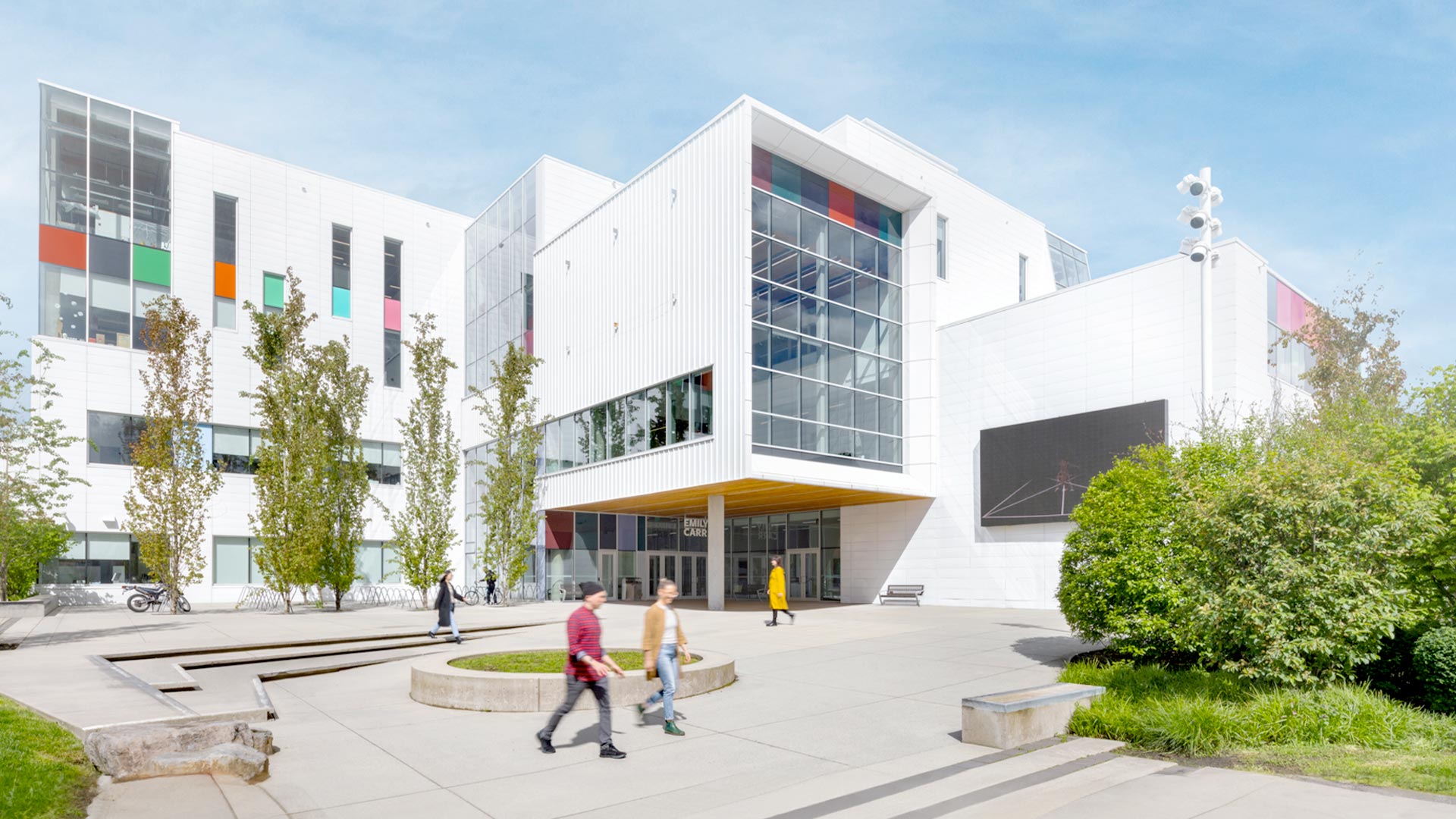
Student Research Initiatives
Emily Carr students are involved in Research projects across the disciplines; Design, Visual Arts, and Media Arts. Here are some examples of current work...
Jen Gellis, MAA Design graduate 2009 – Design for Autonomy and Empowerment
Jen Gellis’ thesis shares a series of explorations involving the design and use of a set of creative research methods to involve children with disabilities in the design process. This project is part of a larger ongoing participatory action research study to design a play space in the therapy department of Sunny Hill Health Centre for Children in Vancouver, BC. Jen’s research, in the MAA program at Emily Carr, has provided her a unique opportunity to study industrial design from her position as an Occupational Therapist. Jen states, exposure to design methods has led to a shift in her approach to working with children with disabilities.
Based primarily on a co-design approach as well as participant observation, this thesis project analyses several sessions with the children who contributed to the design process using a ‘toolkit’. Findings produced a listing of practical suggestions for researchers using similar creative methods in design research with children with disabilities. This exploration, which employs concepts from the sociology of childhood, theory of affordances, sensory integration and client centered practice, illustrates that the toolkit is a valuable, creative, and visual method. It has the potential to be used in pediatric occupational therapy and design practices, as well as research. The insights in this research come from the collaboration between two seemingly different disciplines; industrial design and occupational therapy. This work has hopefully contributed to the understanding of using creative research methods, and provided ideas for future research initiatives that support participation, creativity, autonomy and empowerment of children with disabilities.
Katherine Soucie, BFA graduate 2008 – Fashion, Sustainability and Design
Katherine Soucie is an emerging clothing and textile artist. Having completed studies in Fashion and Textile Design prior to arriving at Emily Carr, Katherine produces work that is a combination of sustainable textile practices, fashion and technology. Successful as a young entrepreneur, Katherine runs her own firm, San Soucie Design (www.sanssoucie.ca).
Since fall 2008 Katherine has had the opportunity to explore and utilize ECU’s Wearables and Interactive Products (WIP) lab. Katherine can be found working on the newly acquired industrial digital embroidery machine. This machine, Katherine says, allows artists and designers the opportunity to produce bodies of work that are either conceptually based or entirely functional. 
With her working knowledge of sustainability in the textiles field, Katherine has found herself questioning the environmental impact of embroidery production within the textile industry. Katherine acknowledges that the stabilizers employed within the embroidery process, and the rayon threads used to create the embellishments are derived from harmful production practices. Her interest within this aspect alone catapulted an investigation into a new production of embroidery that would allow for the use of materials that have little or no environmental impact. Through Katherine's research she plans to develop garments that not only respect the environment, but can also help provide avenues of change within the process and production of embroidery.
Kara Pecknold, MAA Design graduate 2009– Minding the Gap: Communication Design Across the Cultural Divide
From June to September 2008, Kara Pecknold lived and worked as a designer in Rwanda as part of the Association of Universities and Colleges of Canada program, Students For Development. The focus of her internship was to design a website for a cooperative of weavers (known as COVAGA) in the Bugesera District of Rwanda who were working with a problematic plant known as the water hyacinth (Eichhoria crassipes). This plant has wreaked havoc on the lakes and rivers of East Africa to the point that it has covered waterways, thereby causing oxygen depletion, limitations to boat access and a reduction in fish hauls. These weavers have reduced the impacts in their region by extracting the plant and weaving artifacts as a form of environmental protection and economic development. Kara, and Emily Carr film student Mitch Stookey, worked with partner organizations Building Bridges With Rwanda and the University of Agriculture, Technology and Education of Kibungo (UNATEK).
In September 2008, the team exhibited the outcomes of their work along with the weavers at the Museum of Natural History in Kigali. The exhibition was opened by the Minister of Science and Technology, Dr. Romain Murenzi who commended ECUAD and BBR for their contributions toward innovation in Rwanda.
Upon her return from Rwanda, Kara has continued to investigate the role of communication design in a cross-cultural and global context by continuing to work with these weavers (with the help of Lama Mugabo, Executive Director and Co-Founder of BBR who is based in Kigali, Rwanda). Her work considers how a designer must adapt his or her practice when working cross-culturally (where shared language and assumed technologies are not present). The result of her process has been the design of a "field bag" (with disposable cameras and drawing books included) that acts as a desk for participants to use while engaging activities that help a designer assess and understand the actual needs, assets, beliefs and desires of a community before inserting an assumed design solution. Her ideas for this have been framed around the concepts of democracy and good governance, where citizens get to be included in policy development.
Kara aspires to return to Rwanda to see the weavers further develop their weaving skills, build and strengthen their business and become designers in their own right.
Joanna Ambrosio, MAA Design graduate 2009 – Inlak’esh Alaken / From the Mayan language I am you, you are me
Joanna Ambrosio’s research opens a new window in experiential design, combining the visual language, cultural backgrounds, time and space to develop new social engagements with the use of technology.
Joanna’s research is based on the prefix that every city around the globe is home to different cultures and nationalities. Joanna believes that we now have different concepts of local and global, and that the city is still perceived as a local place where our lives have some relevance. This local place still owns different links to global cultures and contexts, and so in the city, our knowledge and new information of different cultures becomes tactile and real. Joanna believes that daily life has become a performance itself.
Using technology and art as bridges between time and space, Joanna’s research Inlak’esh Alaken promotes the development of new ways of intercultural and international communication and participation around the World. With collaborations such as a Day In a Life (Upgrade! Munich) and Tangible Interaction (Vancouver), Joanna uses online network services to communicate with audio and video, which she states, creates the opportunity to open a window into another place. The cities of Vancouver and Guadalajara are the main protagonists, which both witness and participate in the activities of each other.
Joanna’s research is focused on documenting, analyzing and translating the different interactions that two different cultures share. These two windows show a version of a reality untouched by any type of media. Joanna wants her research to serve as an example of the unity we must have as human beings, as part of the same world. She wants it to open our mind to a new perception of ourselves and the environment we live in.
Morgan Rauscher, MAA Media Arts 2010 – Displayduino is born from Arduino roots.
Artist and researcher Morgan Rauscher is working on biofeedback and brain wave interpreting artworks. As part of his journey in combining art and technology at Emily Carr University he has been developing new interactive electronic components (microcontrollers) in collaboration with Toronto-based electrical engineer Randy Glenn.
One of the most widely used interactive technologies in contemporary interactive (new media) art is Arduino. “Arduino is an open-source electronics prototyping platform based on flexible, easy-to-use hardware and software. It's intended for artists, designers, hobbyists, and anyone interested in creating interactive objects or environments.” (http://www.arduino.cc/) However, a more advanced system is required in Morgan’s research because he is dealing with highly sophisticated interactions of the body and mind in his art. Morgan recognized the evolving interactive media arts and the need for more powerful multimedia tools. It is for this reason that as a part of Morgan’s research he is building an expansion of the Arduino technology specifically catering to the needs of modern interactive new media artists. 
Morgans new electronics will allow for 31 inputs and outputs (up from 23 on the Arduino) and use convenient screw terminals as shown in the prototype rendering (image). The board will still function on the Arduino programming language and have up to 4 times the memory of an Arduino board. The new Displayduino also uses RS485 (networking) to control potentially hundreds of ‘daughterboards’ or extended controllers. LED Matrix, Servo Matrix and Magna-Matrix boards will be created as a part of Morgan’s new open source Displayduino architecture and potentially thousands of any kind of electronic device can be controlled using just one Displayduino micro-controller. This means a new era of interactive electronic art can be achieved by artists with modest knowledge of electronics and the expanding world of interactive and immersive electronics can be explored by new media artists.
Morgan Rauscher’s research spans many areas investigating issues of human cognition, interactivity, immersive biofeedback and hyperconscious reflexivity. This requires more advanced electronics controls and new ways of thinking about art-driven electronics projects. Thus, his Displayduino is born from Arduino roots. Morgan plans to offer the plans and code for his new board on his website (open source) as early as this summer and he is using the technology as a part of his thesis research at Emily Carr University to be shown in the spring of 2010.
Miles Thorogood, MAA Media Arts 2010 – Orphone
Miles Thorogood is a creative technologist and practicing sound artist who builds software and hardware technologies for adaptive and interactive artwork systems. Miles has worked with the Australian Commonwealth Scientific and Industry Research Organization in the research and development of projects to facilitate physical connection over computer networks, The Australian National University and the Canberra Rep Theatre 3 in the development of interactive immersive environments. Publications from his research have been included in proceedings of Computer Human Interaction (CHI) 2007, Australasian Computer Music Conference 2006 & 2007 as well as an article in Personal and Ubiquitous Computing, Springer London. He has been involved across disciplines as a freelance media artist and creative and technical consultant with Canadian and international media artists. His academic background includes a Bachelor of Arts, Digital Arts with Honors from The Australian National University.
As a graduate student at Emily Carr, Miles' research involves the study of the operation of natural systems in the design of large area sound installations which use embedded technologies that self adapt to a given environment. One particular context that he is exploring is that of the modern city and the affect of the new soundscape. His practice is concerned with re-engaging the acoustic systems displayed in nature within the sound space of the city. Miles believes that by facilitating an awareness of our surroundings by sound design, we will have a greater appreciation of our environment and community.
Miles' project Orphone is an adaptive sound experience for the extended expression of the body within the urban landscape. Using a mobile device controlled with the human breath and touch people move about the landscape affecting the sound with their interactions. Sound is output over a range of distances through the use of transmitter/ receiver technologies and an extensible loudspeaker system. The sonic adaption of the Orphone searches out an optimal space in the sound band which people interact within, experimenting with the phenomena of sound, space and distance within landscapes.
Miles is working in collaboration with Henry Tsang, Glen Lowry, Simon Levin and Morgan Rauscher in the creation of a multi point networked interactive video project, as well as with David McWilliam in creating a public lighting project in Vancouver.