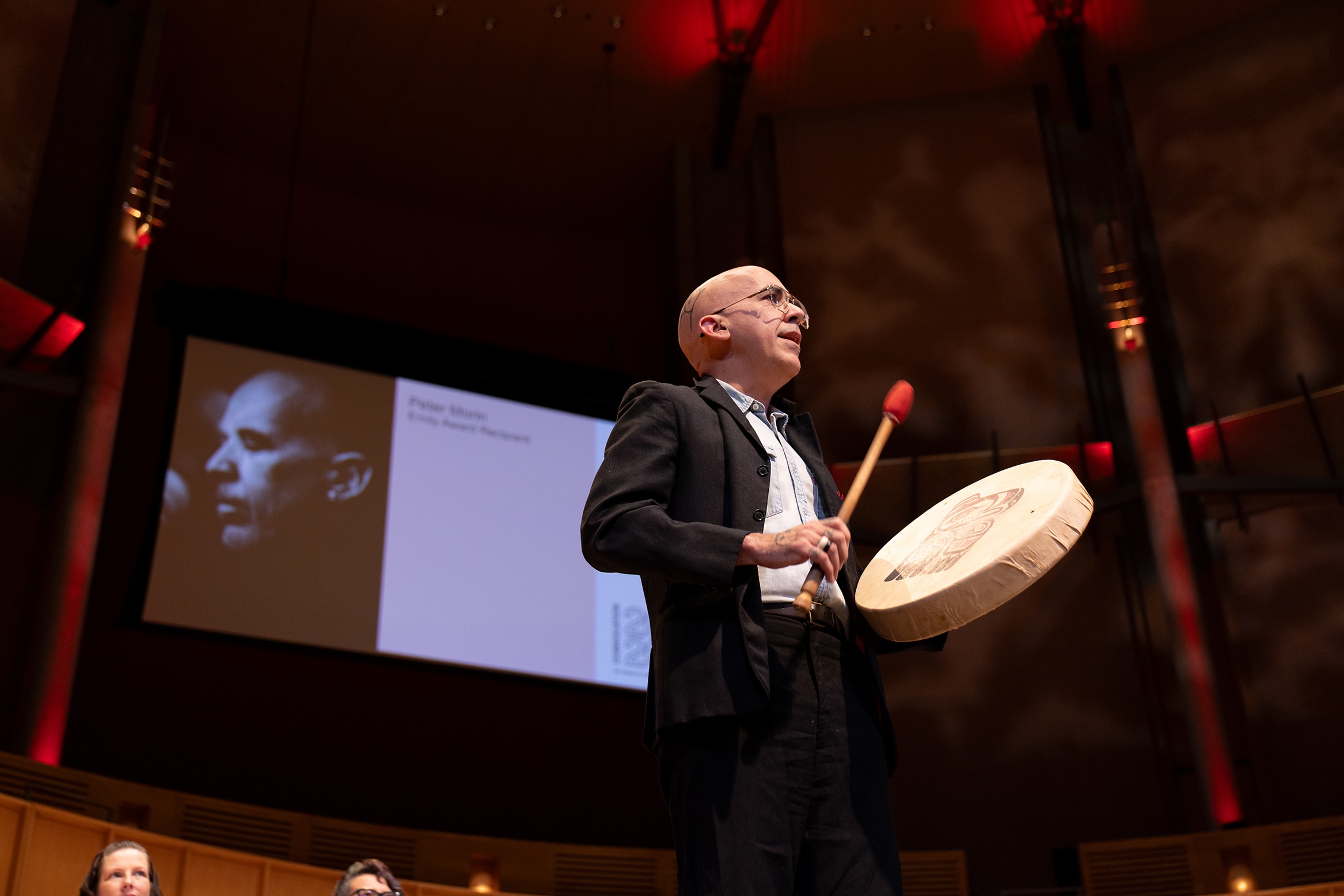
The performance artist, writer, curator, educator and 2026 Emily Award recipient reflects on a quarter century of artmaking, muckraking and leading with love.
Peter Morin (BFA 2001) creeps blindfolded through the Royal Ontario Museum. Hands outstretched, he makes his way to a broad scrim of white paper laid on the museum’s concrete floor. He glues paper feathers together and covers his face in red soil.
“This is a ceremony of connecting to the stories,” intones the performance artist, curator, educator and 2026 Emily Award recipient, “of connecting to the makers of culture.”
His voice tells a story of Big Crow, who schemes a way to bring daylight to the world. Tells a story of a dream — a boy in residential school whose ancestors instruct him to practice his ceremonies in secret. The first story was given to him by his Grandmother Eva. The second came to Peter in a dream.
Standing, Peter brings a finger to his lips. The audience goes quiet. He begins dancing, footsteps echoing around the cavernous space. His moccasins, soles coated in India ink, leave sable prints on the ground. His drum, silent at first, suddenly beats a heart-stopping barrage into the silence — possibly the loudest sound this space has ever held.
He removes his blindfold. He smiles. He teaches the audience Tahltan words: Tsesk’iya (crow) and Ch’iyōne (wolf). And then he teaches them how to dance.
Peter Morin does these things, and then, for nearly 20 years, does not look back. He is looking back now.
Unlike many of Peter’s dozens of performances, this one, titled Two Stories About a Return to the Place Where God Outstretched His Hand, was partially recorded. Filmed in 2007 as part of the imagineNATIVE Film + Media Arts Festival, Peter refers to the video as “found footage” — a portal to the past he’s carried with him but never revisited. Stepping through that portal now, what he sees is a spark that fuelled a flame which has burned ever since.
“In seeing this found footage … I see the beginning of a 20+ year performance art practice,” Peter writes in 2026. “I see all the hands/hearts/spirits that have helped me make my work in community, in gallery, in collaboration. I see the beginning of so many dreams.”
Two Stories was performed as part of Shapeshifters, Time Travellers and Storytellers, an exhibition curated by Candice Hopkins and Kerry Swanson and co-presented by Urban Shaman Gallery. Artists Cheryl L’Hirondelle, Faye Heavyshield (Hon. Deg. 2026), Nadia Myre (BFA 1997), Kent Monkman and Brian Jungen (Alum 1992) were among the esteemed practitioners participating in the show.
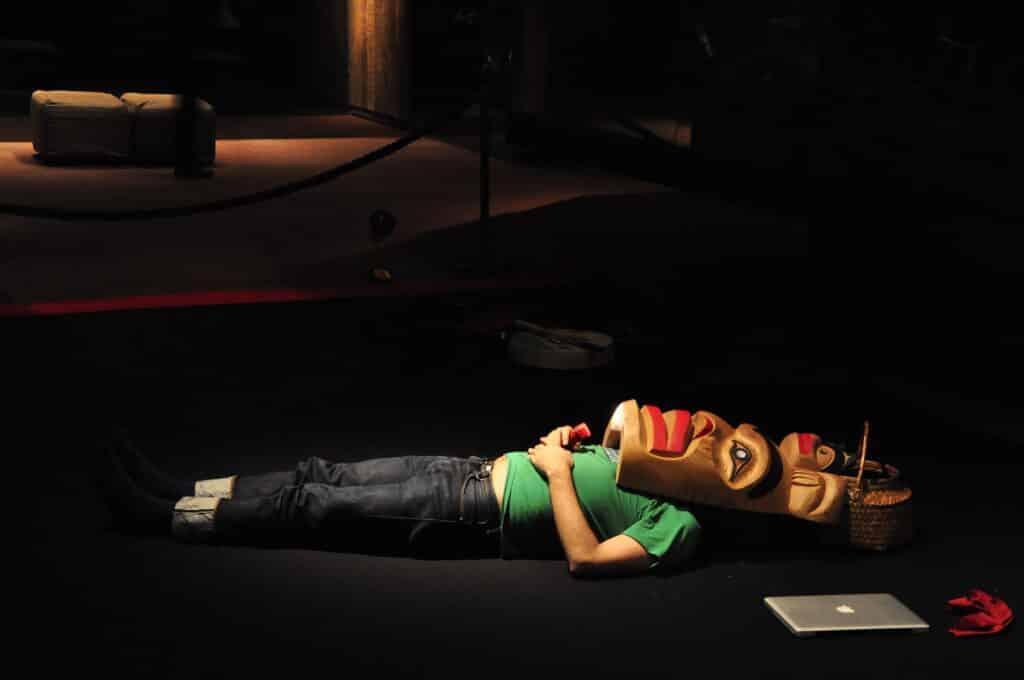
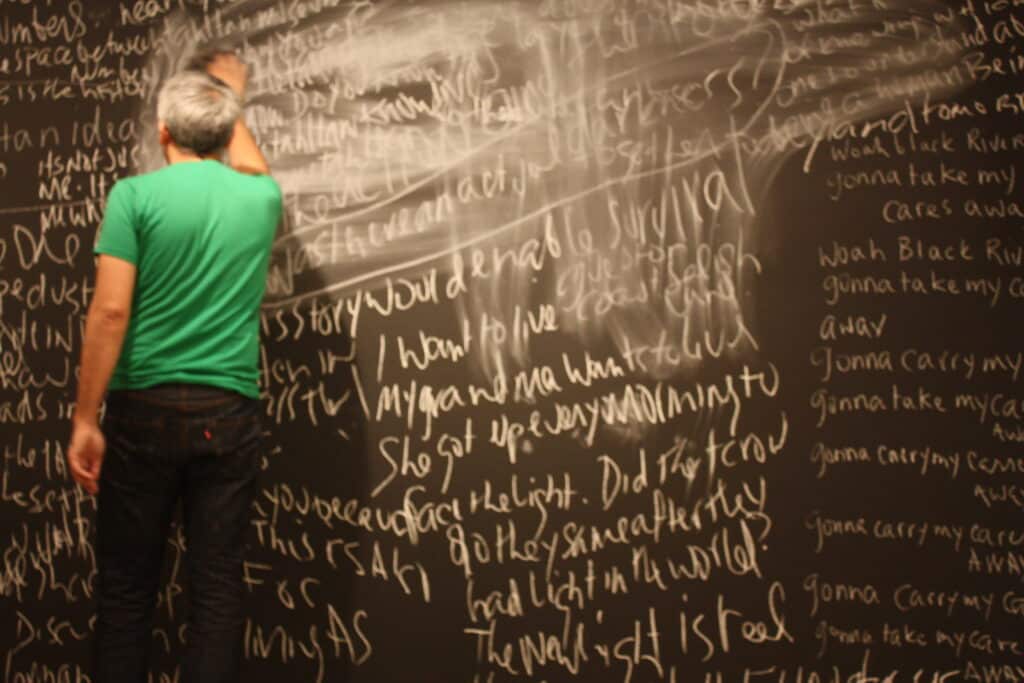
Peter will tell you that this moment changed things for him. That he never intended to be a performance artist. That a confluence of opportunity and privation led him away from lithography, in which he trained at ECU, and deeper into performance practice, helping to shape what has become a form of embodied research. But in describing his approach to both lithography and performance, Peter betrays a sensibility that suggests his move from one into the other might be something less like circumstance and more like fate.
Performance “centres around vulnerability and breath,” and is undertaken in part to “honour how I’ve been transformed.” Meanwhile, lithography “is about rhythmic breath, meditation, presencing, and an intimate sensuousness with the materials. You love that marble or limestone, and you physically transform it through touch.”
Physical presence, breath, transformation, vulnerability and intimacy all aimed at articulating “land/knowing, Indigenous grief/loss, community knowing and … the creative agency/power of the Indigenous body.” This approach has earned Peter high-profile exhibitions and curatorial engagements nationally and internationally, and awards including a Hnatyshyn Foundation Mid-Career Award for Outstanding Achievement as an Artist and a pair of nominations for the prestigious Sobey Art Award.
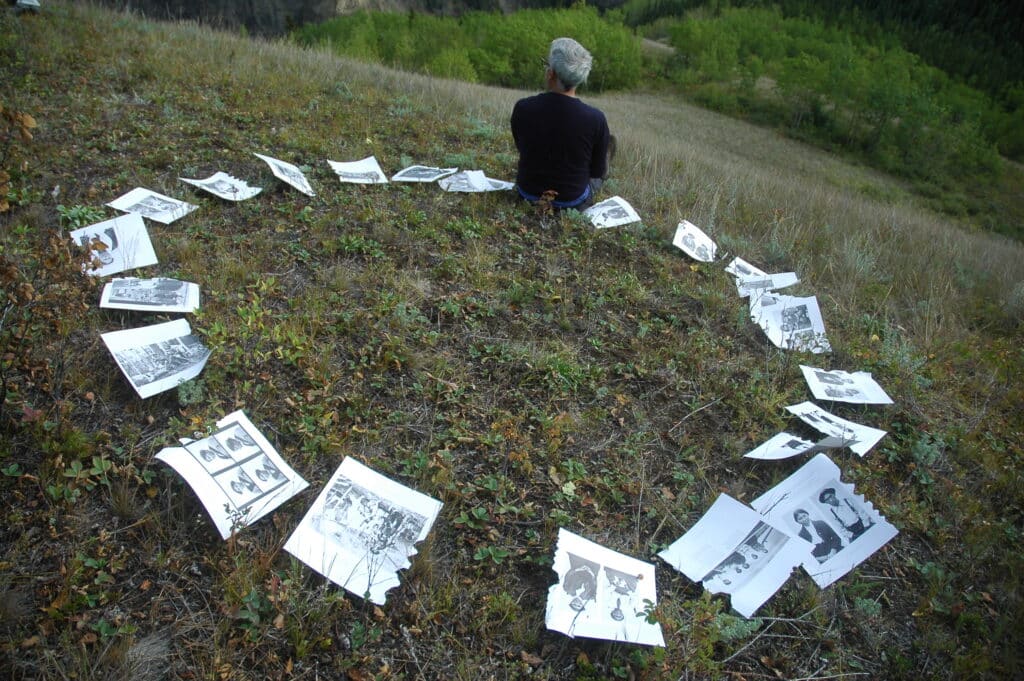
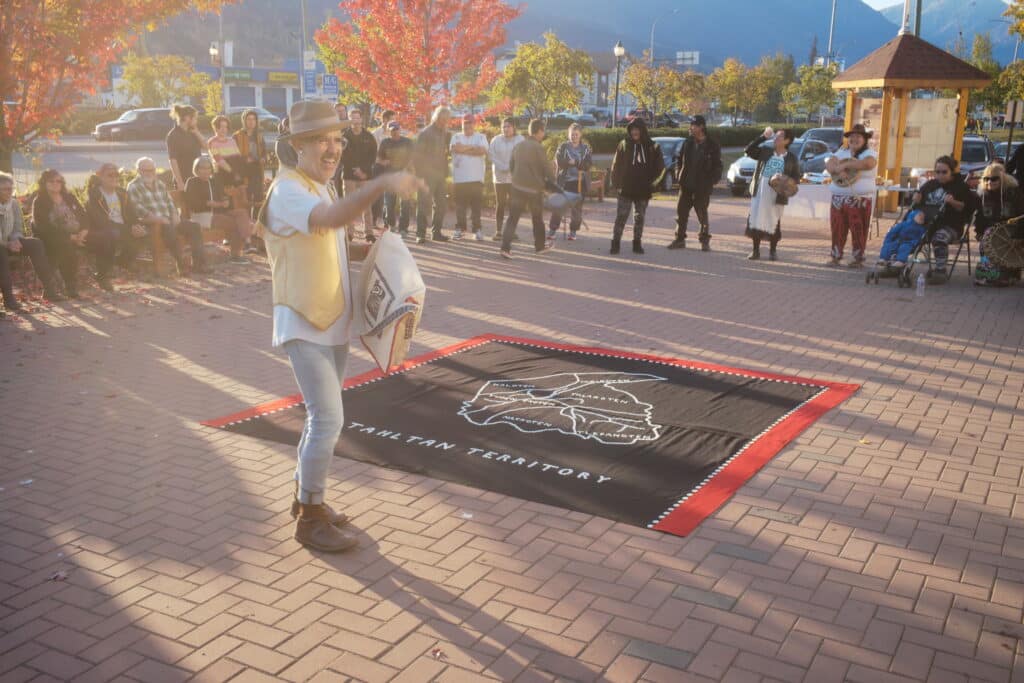
Yet none of it was achieved alone, Peter says. He recounts a youth steeped in community, both around the kitchen table communing with family members and, later, as an art student at ECU, where he looked to Elders including Shirley Bear and Brenda Crabtree to help guide his advocacy for Indigenous students at ECU.
“These moments created resilience, but also what my mom taught me and showed me created resilience,” he says. “My mom taught me that it’s important to stand up for people who can’t even imagine speaking for themselves. She taught me about community. And Brenda and Shirley and Sonny Assu and Daina Warren and Dolores Dallas and Ben Gerow and Doris Whitehead and Rick Campbell and all of us at ECU, we built community together, which is what you see there today.”
Look closely at Peter’s work, and you will see not only the depth of that engagement, but a spirited insistence on acknowledging and foregrounding those influences.
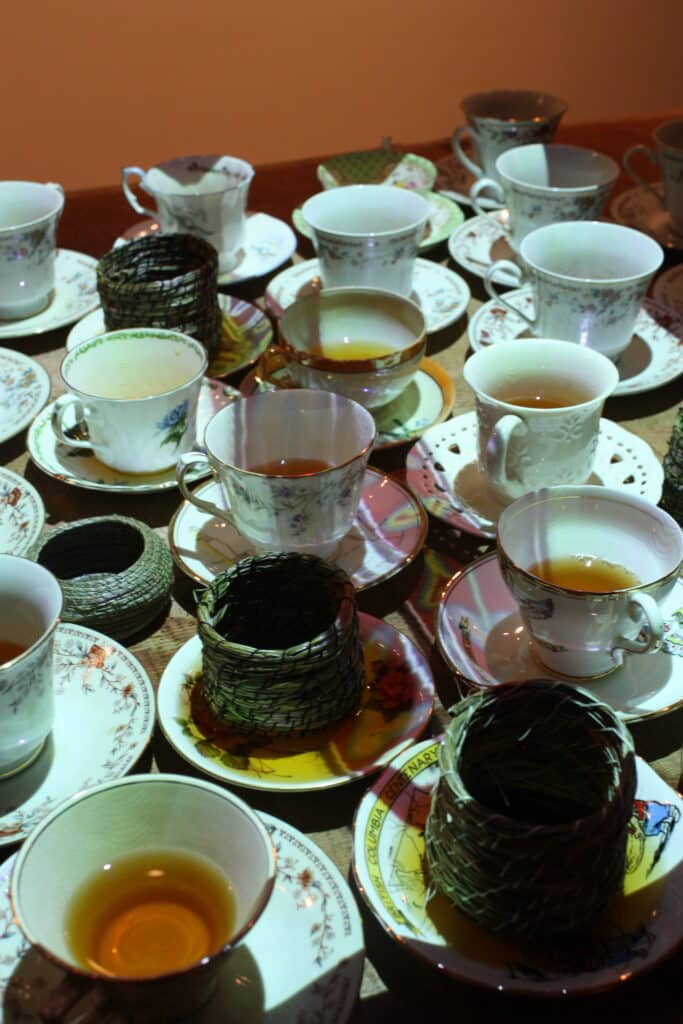
‘Peter Morin’s Museum.’ (Photo courtesy of the Museum of Anthropology at UBC)
In 2013’s Hello Darlin’, Peter sang Conway Twitty’s classic ballad to the totem poles at the Museum of Anthropology. “These totem poles that were cut down and taken from our communities are in a very real way alive. I was imagining they’d broken up with us. I was singing to them, looking them lovingly in the eyes, trying to romance them and bring them back. They weren’t seduced.” His mother, he later reveals, loved Conway Twitty, though he himself found the music “unbearable” growing up. Through that lens, Hello Darlin’ shrugs off the political burden of “reconciliation” to reframe it as an intimate and deeply personal act undertaken by both a penitent son and a playful suitor.
He has included his grandmother’s bone china teacups in performances, worn an “Earth Jacket” embedded with soil from Tahltan land as a kind of “armour,” and characterizes time spent watching television with friend and mentor Faye HeavyShield as an act of “building community.” In other words, not one thing from Peter’s life is wasted. All of it is vital, precious and sacred.
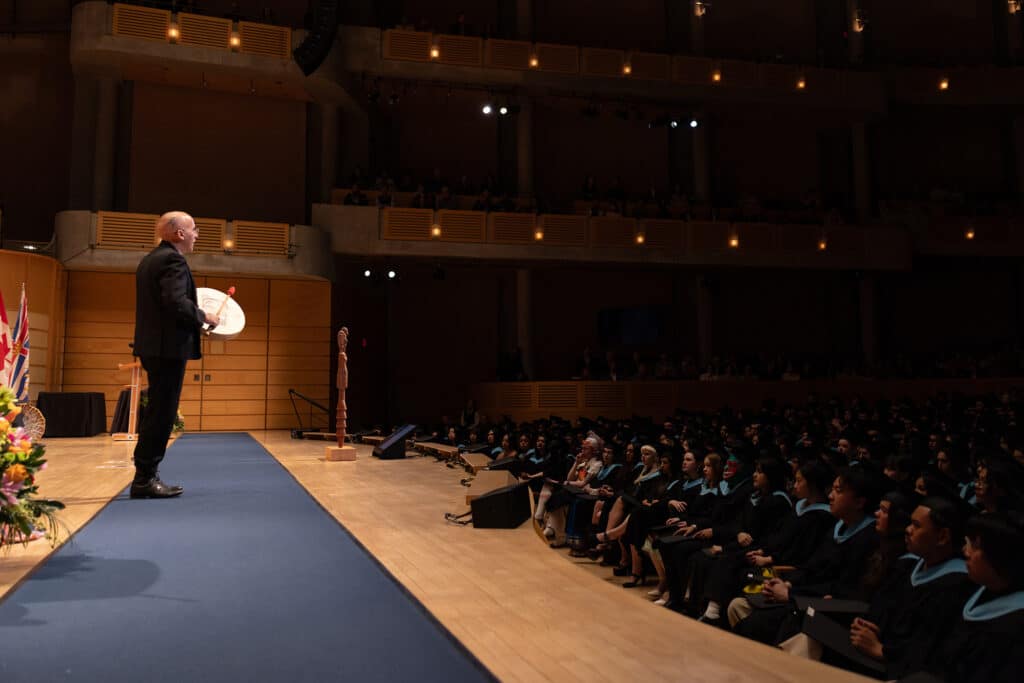
But more than love or simple loyalty, his people are his courage, he says. For instance, in 2013, he travelled to London, UK, as part of the Dream Speaker’s Festival. Peter had learned from historian Coll Thrush that, in 1577, an Inuit baby named Nutaaq had been buried at a London church after being brought as a captive to Britain. With support from longtime collaborator Ayumi Goto and curator Dylan Robinson, Peter wished to visit the church to sing for the lost child. But given their differing nationhoods, he had grave doubts that such a thing would be appropriate.
“I spoke to Elders who told me, ‘You must do this because you are the only one who can. You need to bring sounds from the land to that place so that baby knows the land loved them, and that we loved them.’”
And so, from the pews, he performed a song ceremony for Nutaaq, singing and drumming his grief and love on behalf of a people more than four centuries distant.
And when a year of profound personal loss left him ready to give up artmaking for good, he recalls turning to his grandmother Violet Carlick. “She said, ‘You’re not allowed to quit. You get invited to places where none of us can go, and you need to be an ambassador for our culture in these places. Some of those people will never meet Tahltan people again. You need to be the person they meet.’
“So, that’s what I’ve been doing. For 26 years. And it’s an honour. I have a responsibility because I can be in these places. I’ve been invited, so it is my responsibility and my honour.”
Want more stories like this one delivered twice a month to your inbox?
Subscribe to our free Emix newsletter today!