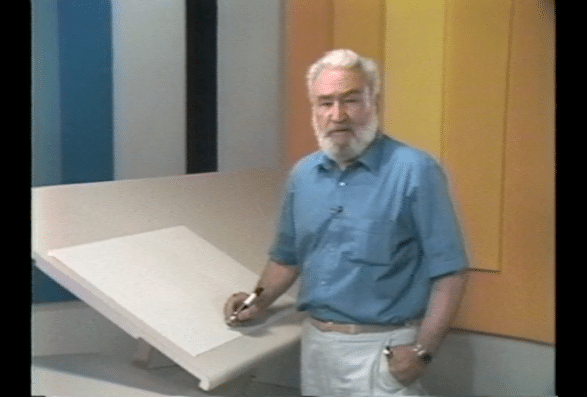
For ECU 100, we look back at the telecourses that broadened the university’s reach in offering artistic training and appreciation to learners across the province.
In the 1980s, as new technologies such as VCRs and portable music revolutionized how people experience media, educators at Emily Carr University of Art + Design (ECU) saw an opportunity to transform the way arts education could be delivered to learners across the province.
From as early as 1983, ECU staff and faculty began experimenting with telecourses— art lessons beamed directly to people’s televisions and available as VHS cassettes for on-demand viewing.
A rich catalogue of records in the ECU archives reveals the innovative efforts of these educators to create province-wide accessibility to an education aimed at expanding artistic knowledge and teaching foundational skills in drawing and painting.
The Early Beginnings of the Telecourses
Nini Baird, Outreach Program Director from 1977 to 1987, began investigating the option of telecourses in the early ‘80s. Through her travels across the province, Nini found there was a strong desire for accredited art courses in regional hubs such as Prince George, Terrace, Nelson, and beyond.
“What was really unique about the Outreach program was that it partnered with communities – it reached out to ask what the need was before acting,” says Kristy Waller, ECU Archivist. “A lot of those partnerships came out of long conversations with rural community members about what they needed. Nini travelled to different communities and talked directly with people to understand how ECU could fill this role as a provincial resource based on what communities were saying”
Through solidifying partnerships with Open Learning Institute, the Knowledge Network and the Provincial Educational Media Centre, Nini and her team created the first telecourse “Contemporary Art in Canada” was a historical course delving into the ideas and practices of Canadian artists from 1850 to the present. The course was distributed on VHS to students and was concurrently broadcast on the Knowledge Network.
By harnessing the nascent technology of videos, the telecourses brought arts education to the province and helped develop public appetite for artistic expression. The courses reached over 15,000 viewers on the Knowledge Network in 1986, and student feedback revealed that quite a sizable number were homemakers, art teachers and mothers who used these courses to expand their horizons.
One such student mentioned, “I feel so fortunate to be taking this excellent course. It is well thought out. Readings are well chosen. It is a very exciting course and because of it my ‘visions’ are expanded and opened wider,” Another student opined that “I hope you will offer [these courses] again next year. The quality overall was excellent – stimulating, well-produced programming – a significant source of ideas for those living in isolated areas.”
These anecdotal remarks from early students were instrumental in developing subsequent telecourses. And in Tom Hudon — then co-Principal of ECU and Dean of Instruction — a British Canadian analogue to Bob Ross was born.
Tom Hudson: The Colour Man
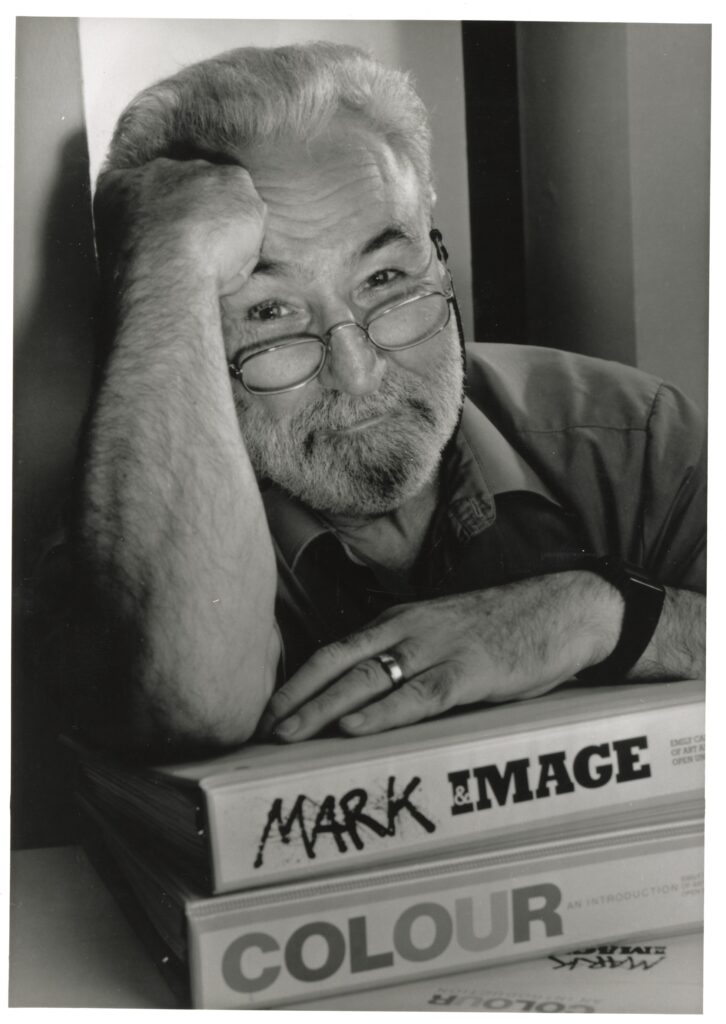
Tom Hudson was an influential figure in ECU’s history and a true advocate for equitable and accessible arts education. His work garnered international recognition, and he served as a key resource in the International Society of Education through Art and World Congress of Art Education. He also co-curated Celebration 86, an exhibition for Expo ‘86 featuring artworks by children from over 50 countries.
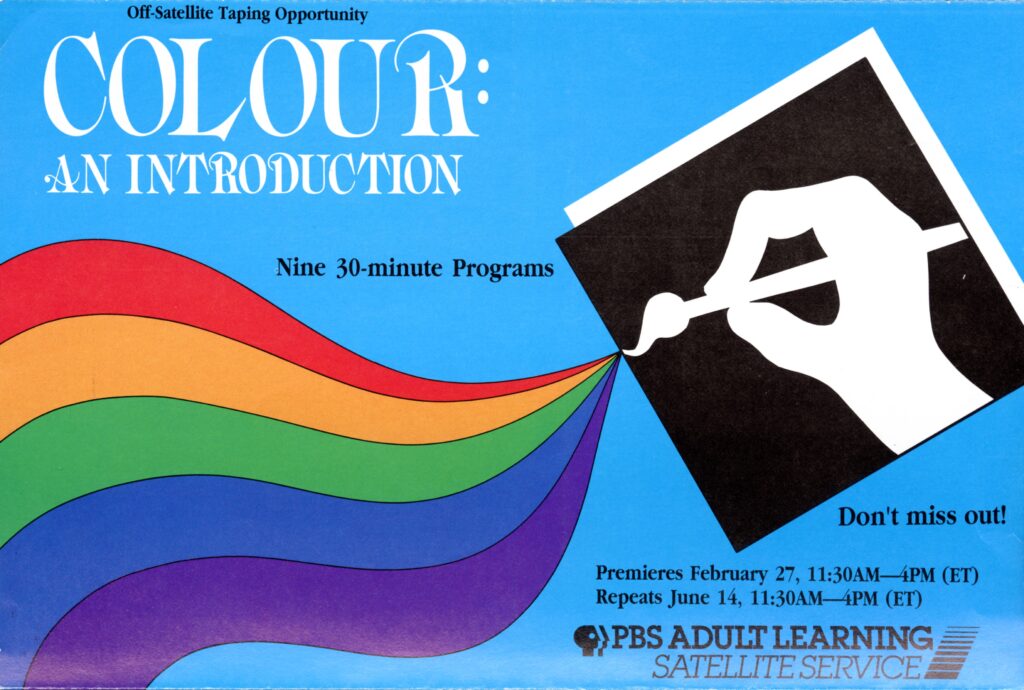
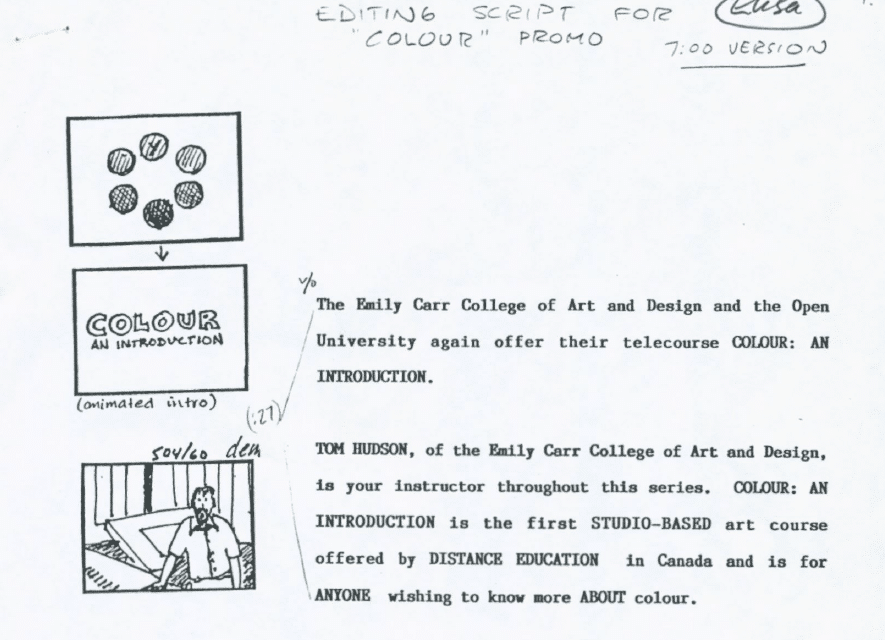
Thanks to his impressive oratorical skills and passion for the arts, Tom was the perfect fit for the telecourses. Prior to his retirement in 1987, the Outreach team worked closely with Knowledge Network producers to distill Tom’s granular knowledge into a series titled ‘Colour: An Introduction.’ Over six one-hour episodes, the practice-based course explored the use of colour in artworks, the emotions it elicits in a viewer, and its visual implications.
“Tom was really interested in broad-reaching arts education,” says Kristy. “Not arts education as a way to become an artist, necessarily, but as a way to understand art: its role in society, the importance of culture, and making art more accessible and available to people. And these programs, through his involvement in them, really show that.”
When the course was broadcast on Knowledge Network in 1987, it was a resounding success for the Outreach team. It also established Tom’s new reputation as the “Colour Man” to BC viewers. Even after retirement, he continued to work with ECU and its partners to develop three more telecourses: ‘Mark & Image’ (1988), ‘Material & Form’ (1991) and ‘Understanding Modern Art’ (1994).
After the Telecourses
When the Outreach program disbanded in 1994 due to funding issues and internal planning, letters flooded in from concerned citizens across BC expressing their dismay and sadness that such a vital link to arts programming would be lost.
“You can see people saying in letters that there was going to be a real lack of arts in their towns if the program was taken away, and talking about the impact it had on their communities,” says Kristy, who notes that telecourses and other outreach initiatives nevertheless helped shape the cultural vocabulary of communities throughout the province. Decades before online learning was the norm, ECU’s telecourses demonstrated an eagerness to experiment with emerging technologies to expand access to arts education and engage a broader public in conversations about artmaking.
“I imagine the legacy is that the people who were able to take those courses developed an appreciation for the arts and then carried that with them. Maybe they brought it into their classrooms, into their homes with their kids, or into conversations with their neighbours. Maybe some of those conversations even led people to Emily Carr.”
100 Years of Creativity: The Stories that Shaped Us
As part of Emily Carr University’s centennial celebrations and our ‘100 Years of Creativity’ campaign, we are sharing stories that spotlight the creativity, resilience and impact of our community over the past 100 years. These stories feature the people, projects, places and ideas that have shaped ECU, reminding us of our shared legacy while inspiring the future. By revisiting past milestones and sharing new ones, we honour the many voices that built our institution and continue to guide its path forward.
For more information about ECU 100 centennial celebrations, upcoming events and stories, visit our webpage.